Only You Can Stop Trumpacans Funny
Facts matter: Sign upward for the free Mother Jones Daily newsletter. Back up our nonprofit reporting. Subscribe to our print magazine.
In a framed photo of herself taken in 2007, Sharon Galicia stands, fresh-faced and beaming, beside first lady Laura Bush at a Washington, DC, luncheon, thrilled to exist honored as an outstanding GOP volunteer. We are in her office in the Aflac insurance company in Lake Charles, Louisiana, and Sharon is heading out to pitch medical and life insurance to workers in a bleak corridor of industrial plants servicing the rigs in the Gulf of Mexico and petrochemical plants that make the plastic feedstock for everything from car seats to bubble glue.
After a twenty-minute drive along flat terrain, we pull into a dirt parking lot abreast a cerise truck with a decal of the Statue of Liberty, her raised arm holding an G-16. A man waves from the entrance to an enormous warehouse. Warm, attractive, well-spoken, Sharon has sold a lot of insurance policies around hither and made friends forth the way.
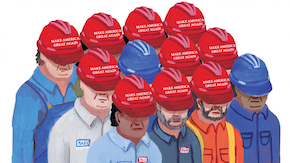
A policy with a weekly premium of $5.52 covers accidents that aren't covered by a worker's other insurance—if he has any. "How many of you can go a week without your paycheck?" is function of Sharon'south pitch. "Ordinarily no hands go up," she tells me. Her clients repair oil platforms, cut canvas metal, set refrigerators, process chicken, lay cobblestone, and dig ditches. She sells to entry-level flooring sweepers who make $8 an hr and can't afford to get sick. She sells to flaggers in highway repair crews who earn $12 an hour, and to welders and operators who, with overtime, make upward to $100,000 a twelvemonth. For near, didactics stopped after high school. "Pipe fitters. Ditch diggers. Asphalt layers," Sharon says. "I tin can't find 1 that'southward non for Donald Trump."
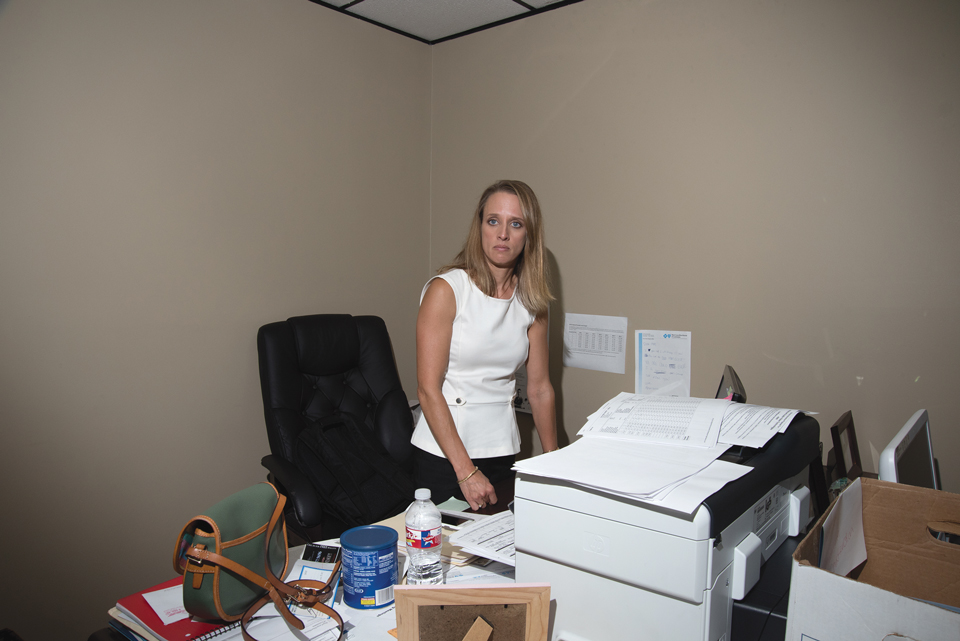
Sharon Galicia sells accident insurance to Louisiana laborers. Stacy Kranitz
I first met Sharon at a gathering of tea party enthusiasts in Lake Charles in 2011. I told them I was a sociologist writing a book about America's e'er-widening political dissever. In their 2008 book, The Big Sort, Bill Bishop and Robert Cushing showed that while Americans used to move mainly for individual reasons like higher-paid jobs, nicer weather, and meliorate homes, today they as well prioritize living nearly people who think like they do. Left and Right have go subnations, as George Saunders recently wrote in The New Yorker, living like housemates "no longer on speaking terms" in a house gear up afire by Trump, gaping at 1 another "through the fume."
I wanted to get out my subnation of Berkeley, California, and enter another as far right equally Berkeley is to the left. White Louisiana looked like it. In the 2012 election, 39 percent of white voters nationwide cast a ballot for President Barack Obama. That effigy was 28 percentage in the S, but about 11 percent in Louisiana.
To try to understand the tea party supporters I came to know—I interviewed sixty people in all—over the next five years I did a lot of "visiting," as they call it. I asked people to show me where they'd grown up, been baptized, and attended school, and the cemetery where their parents had been cached. I perused high school yearbooks and photograph albums, played cards, and went fishing. I attended meetings of Republican Women of Southwest Louisiana and followed the campaign trails of two correct-wing candidates running for Congress.
When I asked people what politics meant to them, they often answered past telling me what they believed ("I believe in liberty") or who they'd vote for ("I was for Ted Cruz, but now I'grand voting Trump"). Merely running beneath such beliefs similar an underwater leap was what I've come to think of as a deep story. The deep story was a feels-as-if-it's-truthful story, stripped of facts and judgments, that reflected the feelings underpinning opinions and votes. It was a story of unfairness and anxiety, stagnation and slippage—a story in which shame was the companion to need. Except Trump had opened a divide in how tea partiers felt this story should end.
Information technology was a story of unfairness and anxiety, stagnation and slippage—a story in which shame was the companion to need.
"Hey Miss Sharon, how ya' doin'?" A fiftysomething human being I'll call Albert led us through the warehouse, where sheet metal had been laid out on large tables. "Desire to come over Saturday, help us brand sausage?" he called over the eeeeech of an unseen electrical saw. "I'1000 seasoning information technology dissimilar this year." The year earlier, Sharon had taken her 11-year-old daughter along to assist stuff the spicy smoked-pork-and-rice sausage, to which Albert added ground deer meat. "I'll bring Alyson," Sharon said, referring to her girl. Some days they'd accept 400 pounds of deer meat and offer her some. "They're actually good to me. And I'm there for them also when they demand something."
These men had little shelter from bad news. "If y'all dice, who'south going to bury you?" Sharon would ask on such calls. "Do you have $ten,000 sitting around? Will your parents have to borrow money to bury you or your wife or girlfriend? For $1.44 a week, you become $20,000 of life insurance."
Louisiana is the country's third-poorest state; 1 in 5 residents live in poverty. It ranks tertiary in the proportion of residents who get hungry each year, and dead terminal in overall health. A quarter of the country's students drop out from high school or don't graduate on time. Partly as a result, Louisiana leads the nation in its proportion of "disconnected youth"—20 percent of 16- to 24-yr-olds in 2013 were neither in school nor at work. (Nationally, the effigy is xiv percent.) Merely 6 percent of Louisiana workers are members of labor unions, nearly half the charge per unit nationwide.
Louisiana is too home to vast pollution, especially along Cancer Alley, the 85-mile strip along the lower Mississippi between Billy Rouge and New Orleans, with some 150 industrial plants where in one case there were sugar and cotton wool plantations. According to the American Cancer Lodge, Louisiana had the nation's second-highest incidence of cancer for men and the fifth-highest rate of male deaths from cancer. "When I make a presentation, if I say, 'How many of you know someone that has had cancer?' every hand is going to go up. Just the other day I was in Lafayette doing my enrollments for the insurance, and I was talking to this one guy. And he said, 'My blood brother-in-police but died. He was 29 or 30.' He'due south the third person working for his company that's been in their early 30s that's died of cancer in the concluding iii years. I file tons and tons of cancer claims."
Sharon also faced economic uncertainty. A divorced female parent of two, she supported herself and 2 children on an aplenty but erratic income, all from committee on her Aflac sales. "If you're starting out, you might get 99 'noes' for every one 'yeah.' Subsequently 16 years on the task, I get l percent 'yeses.'" This put her at the top among Aflac salespeople; still, she added, "If information technology'south a slow month, we eat peanut butter."

The yard of a Trump supporter Stacy Kranitz
Until a few years agone, Sharon had also nerveless rent from fourscore tenants in a trailer court. Her ex-husband earned $40,000 every bit a sales manager at Pacific Sunwear, she explained, and helped with child support; altogether it immune her to pay her children'southward tuition at a parochial schoolhouse and stay electric current on the mortgage of a tastefully furnished, spacious ranch house in suburban Moss Bluff. She lived in the anxious middle.
And from this vantage point, the lives of renters in her trailer park, chosen Crestwood Community, had both appalled and unnerved her. Some of her tenants, lxxx percent of whom were white, had matter-of-factly admitted to lying to get Medicaid and food stamps. When she'd asked a male child her son's age well-nigh his plans for the future, he answered, "I'm just going to go a [disability] cheque, similar my mama." Many renters had been, she told me, able-bodied, idle, and on disability. I fellow had claimed to have seizures. "If you accept seizures, that's about a surefire way to get disability without proving an ailment," she said. A lot of Crestwood Community residents supposedly had seizures, she added. "Seizures? Actually?"
Every bit nosotros drove through the vacated lot, we passed abased trailers with doors flung open, alpine grass pockmarked with holes where mailboxes in one case stood. Unable to pay an astronomical water bill, Sharon had been forced to close the trailer park, giving residents a calendar month's detect and provoking their resentment.
In truth, Sharon felt relief. Her renters, she said, had been a hard-living lot. A jealous boyfriend had murdered his girlfriend. Some men drank and crush their wives. One human being had married his son's ex-wife. Beyond that, Sharon had felt unfairly envied by them. "I've been called a rich bowwow. They recall Miss Sharon lives the life of Riley." And while her habitation was a 25-minute bulldoze away, the life of her renters had felt entirely too shut for comfort. "Yous couldn't talk to anyone at Crestwood whose teeth weren't falling out, gums black, missing teeth," adding that she gave out toothbrushes and toothpaste one Christmas. "My kids make fun of me because I brush my teeth so much."
To her, the trailer park both did and did not feel worlds away. For i matter, a person'southward standard of living, their worldview and bones identity, seemed already assault a floor of Jell-O. Who could know for sure how yous would fare in the era of an expanding bottom, spiking top, and receding middle class?
Sharon's maternal granddaddy had established a successful line of local furniture stores and shown how far up a man with gumption could rise. Sharon herself had graduated magna cum laude from McNeese State University in Lake Charles and been elected president of Republican Women of Southwest Louisiana. Simply her youngest brother had dropped out of high schoolhouse and, while very bright and able-bodied, had non establish his manner. Her father, a found worker who'd left her mom when Sharon was a teen, had remarried and moved to a trailer in Sulphur with his new married woman, a mother of four. Looking around her, Sharon saw family and friends who struggled with bad relationships and joblessness. Some collected food stamps. "I don't get it," she said, "and it drives me nuts."
For Sharon, being on the dole raised basic issues of duty, accolade, and shame. It had been hard to collect rent that she knew derived from disability checks, paid, in the end, by hardworking taxpayers like her. "I pay $nine,000 in taxes every twelvemonth and nosotros get nothing for information technology," she said. Like others I interviewed, she felt that the federal government—especially under President Obama—was bringing down the hardworking rich and struggling center while lifting the idle poor. She'd seen it firsthand and information technology felt unfair.
"He's had similar eight surgeries. He'south still working, though. He doesn't want anything from the regime. He'south such a slap-up guy."
Equally we drove from the trailer park to her abode, Sharon reflected on human ambition: "You lot can just see it in some guys' eyes; they're aiming college. They don't desire a handout." This was the central signal of one of Sharon'southward favorite books, Barefoot to Billionaire, by oil magnate Jon Huntsman Sr. (whose son ran in the 2012 Republican presidential master). Ambition was good. Earning money was good. The more than coin yous earned, the more than yous could give to others. Giving was adept. So ambition was the key to goodness, which was the basis for pride.
If you could work, even for pennies, receiving authorities benefits was a source of shame. Information technology was okay if you were one of the few who really needed it, but not otherwise. Indignation at the overuse of welfare spread, in the minds of tea party supporters I got to know, to the federal government itself, and to state and local agencies. A retired assistant fire chief in Lake Charles told me, "I got told we don't need an assistant burn down chief. A lot of people around hither don't like any public employees, autonomously from the police." His wife said, "We were making such depression pay that nosotros could take been on nutrient stamps every month and other welfare stuff. And [an official] told our departments that if we went and got food stamps or welfare it would look bad for Lake Charles so that he would fire u.s.." A public school instructor complained, "I've had people tell me, 'It's the teachers who need to pass the kids' tests.' They take no idea what I know." A social worker who worked with drug addicts said, "I've been told the church building should take care of addicts, non the regime." Both receivers and givers of public services were tainted—in the eyes of well-nigh all I came to know—by the very touch of authorities.
Sharon especially admired Albert, a centre-aged canvas metal worker who could have used assist but was as well proud to enquire for it. "He's had open-heart surgery. He's had stomach surgery. He'due south had like eight surgeries. He'southward still working, though. He wants to work. He's got a girl in jail—her third DUI, so he's raising her son—and this and that. But he doesn't want anything from the government. He's such a neat guy." There was no mention of the need for a adept alcoholism rehab plan for his girl or after-school programs for his grandson. Until a few days before his death Albert continued working, head loftier, shame-costless.
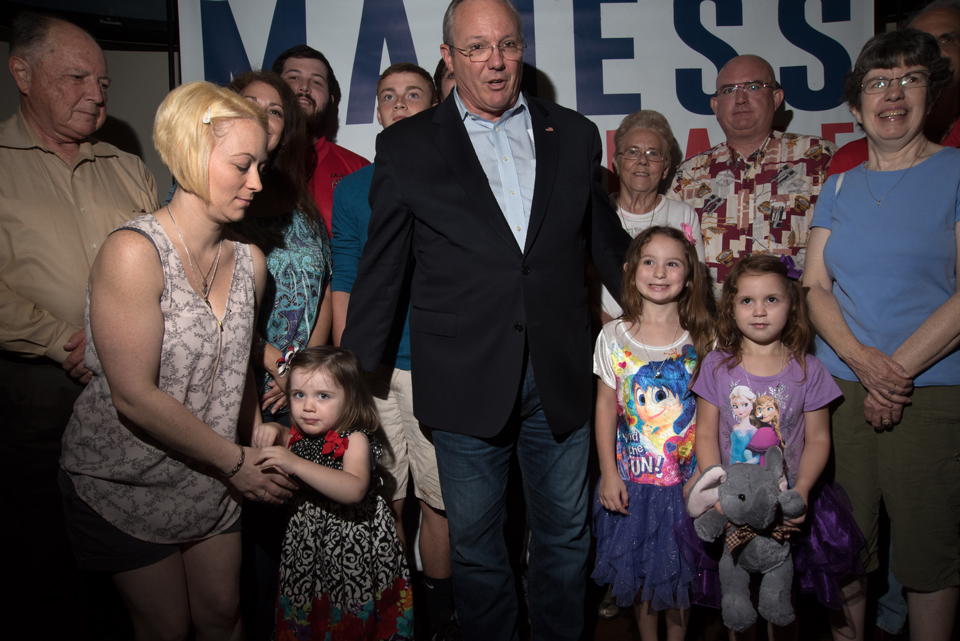
Rob Maness, a Republican candidate for United states of america Senate in Louisiana, speaks at a tea party encounter-and-greet. Stacy Kranitz
Sharon's politics were partly rooted, it seemed, in the class slippage of her babyhood. As the oldest of three, the "piffling mama" to two younger brothers, she said, "I got them up in the morning, made their beds for them, so my mama wouldn't come up downwardly difficult on them." Sharon's mother, the daughter of that prosperous furniture shop owner, had grown up with a black maid who'd fabricated her bed for her. She'd married a highly intelligent only high-school-educated plant worker, a Vietnam vet who never spoke of the war and seemed in search of peace and quiet. Privileges came and went in securely unsettling means and made a person want to hold on to a reassuring past. "One time when I had to travel to Florida on work, I left the kids with my mom, and Bailey called me for help: 'Grandma's forcing me to brand her bed!'" Sharon answered, "I'one thousand really sorry, Bailey; make her bed."
With the proud retentiveness of an affluent Southern white girlhood, her female parent took a dim view of the federal regime. She'd trained every bit a social worker, volunteered in a women's prison house, and remembered its inmates in her daily prayer. A devoted Christian, Sharon's mother believed in a generous church. But regime benefits were a very different story. Taking them meant you lot'd fallen and weren't proudly trying to rise back up.
As we pulled upwardly to her abode, Sharon reflected on various theories her mother had. "Take y'all heard of the Illuminati? The New World Gild?" Sharon asked and then as to prepare me. "I'm tea party," Sharon said, "but I don't go forth with a lot that my mom does." Whether they clung to such dark notions or laughed them off, tea party enthusiasts lived in a roaring rumor-sphere that offered answers to deep, constant anxieties. Why did President Obama have off his wristwatch during Ramadan? Why did Walmart run out of armament on the third Tuesday in March? Did y'all know drones tin can discover how much money y'all have? Many described these as suspicions other people held. Many seemed to float in a zone of half-conventionalities.
The about widespread of these suspicions, of course—shared past 66 percentage of Trump supporters—is that Obama is Muslim.
What the people I interviewed were drawn to was not necessarily the particulars of these theories. Information technology was the deep story underlying them—an account of life as it feels to them. Some such account underlies all beliefs, right or left, I think. The deep story of the right goes like this:
You are patiently continuing in the middle of a long line stretching toward the horizon, where the American Dream awaits. But as you lot look, you lot see people cutting in line ahead of you. Many of these line-cutters are black—beneficiaries of affirmative activity or welfare. Some are career-driven women pushing into jobs they never had before. And so y'all encounter immigrants, Mexicans, Somalis, the Syrian refugees yet to come. As you wait in this unmoving line, you lot're beingness asked to feel sorry for them all. You have a good middle. Simply who is deciding who you should feel compassion for? And so you see President Barack Hussein Obama waving the line-cutters forward. He's on their side. In fact, isn't he a line-cutter too? How did this fatherless black guy pay for Harvard? As you lot await your turn, Obama is using the money in your pocket to aid the line-cutters. He and his liberal backers have removed the shame from taking. The regime has go an instrument for redistributing your money to the undeserving. It's not your regime anymore; it's theirs.
I checked this distillation with those I interviewed to see if this version of the deep story rang truthful. Some contradistinct it a bit ("the line-waiters form a new line") or emphasized a particular point (those in back are paying for the line-cutters). Just all of them agreed it was their story. 1 man said, "I live your analogy." Another said, "Y'all read my mind."
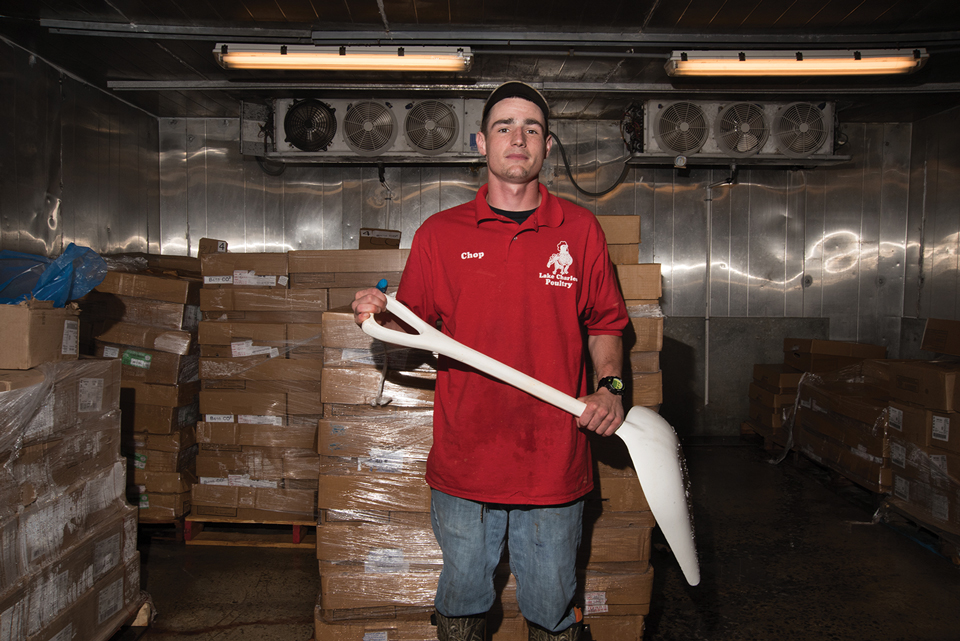
A poultry worker in Lake Charles Stacy Kranitz
The deep story reflects pain; you've done everything right and you're still slipping back. Information technology focuses blame on an sick-intentioned government. And it points to rescue: The tea party for some, and Donald Trump for others. But what had happened to make this deep story band true?
Well-nigh of the people I interviewed were middle form—and nationally more than than half of all tea party supporters earn at least $50,000, while nigh a third earn more than than $75,000 a twelvemonth. Many, all the same, had been poor every bit children and felt their rise to accept been an uncertain 1. As i wife of a well-to-do contractor told me, gesturing around the buck heads hanging above the large stone fireplace in the spacious living room of her Lake Charles home, "We have our American Dream, but we could lose information technology all tomorrow."
Being centre class didn't hateful you felt secure, because that course was thinning out as a tiny elite shot up to nifty wealth and more than people roughshod into a life of cleaved teeth, unpaid rent, and shame.
Growing upwardly, Sharon had felt the struggle it took for her family to "stand in line" in a tumultuous world. Three years subsequently her father wordlessly left home when she was 17, Sharon married, presently embracing a covenant marriage—i that requires premarital counseling and sets stricter grounds for divorce. Only then they did divorce, and Sharon, one time the little mother to her own siblings, now found herself a single female parent of two—a mom and dad both. She was doing her level best merely wondered why the travails of others then often took precedence over families such as her ain. Affirmative-Action blacks, immigrants, refugees seemed to so routinely receive sympathy and government help. She, too, had sympathy for many, just, as she saw it, a liberal sympathy machine had been assail automatic, disregarding the giving capacity of families like hers.
Or as ane tea partier wrote to me: "We're so broke. Where does this food & welfare money come from? How can complimentary stuff (including college, which my iv.ii educatee needs) even be on the table when the US owes $nineteen,343,541,768,824.00 as of July i? Is it just me or does it seem like the merely thing ANYONE cares nearly is themselves and their immediate circumstances?"
Pervasive among the people I talked to was a sense of disengagement from a afar elite with whom they had ever less contact and less in common. And, as older white Christians, they were acutely aware of their demographic refuse. "Y'all tin't say 'merry Christmas,' y'all accept to say 'happy holidays,'" i person said. "People aren't clean living anymore. You're considered ignorant if you're for that." An auditor told me, "Other people say, 'You lot're likewise difficult-nosed about [morals].' Better to be difficult-nosed than to be like information technology is now, and so permissive most everything." They also felt disrespected for holding their values: "You lot're a weak woman if you don't believe that women should, you know, but elbow your manner through society. You're non in the 'in' crowd if you're not a liberal. You're an old-fashioned old fogey, small thinking, small town, gun loving, religious," said a minister's married woman. "The media tries to brand the tea political party expect like bigots, homophobic; information technology'southward not." They resented all labels "the liberals" had for them, especially "backward" or "ignorant Southerners" or, worse, "rednecks."
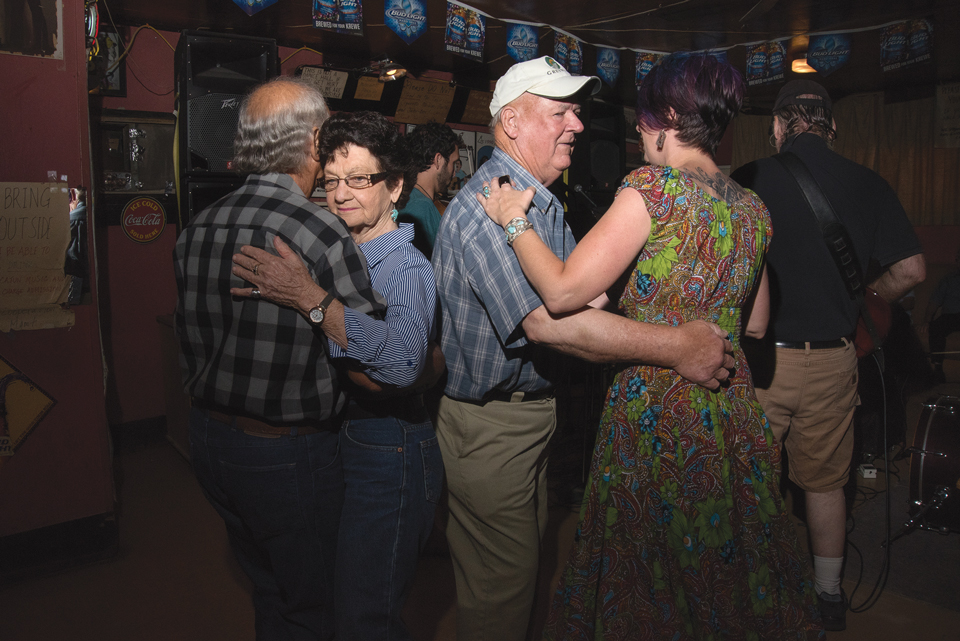
Dancing to a Cajun band at Fred's Lounge in Mamou, Louisiana Stacy Kranitz
Liberal television pundits and bloggers took easy potshots at them, they felt, which hardened their defenses. Their Facebook pages then filled with news coverage of liberals beating up fans at Trump rallies and Fox News coverage of white policemen shot by blackness men.
For some, historic period had also become a source of humiliation. Ane white evangelical tea party supporter in his early 60s had lost a good job as a sales manager with a telecommunications company when information technology merged with another. He took the stupor bravely. Only when he tried to go rehired, it was terrible. "I called, emailed, called, emailed. I didn't hear a affair. That was totally an age bigotry matter." At final he found a chore at $x an hour, the same wage he had earned at a summer mill union job as a higher student 40 years ago. Age brought no dignity. Nor had the privilege linked to being white and male trickled down to him. Like Sharon'south clients in the petrochemical plants, he felt like a stranger in his ain country.
Only among those walking in this wilderness, Trump had opened upwards a divide. Those more in the middle grade, such as Sharon, wanted to halt the "line-cutters" by slashing authorities giveaways. Those in the working course, such as her Aflac clients, were drawn to the idea of hanging on to government services merely limiting access to them.
Sharon was a giving person, only she wanted to roll dorsum government help. It was difficult supporting her kids and being a adept mom too. Managing the trailer park had called on her dust, determination, fifty-fifty hardness—which she regretted. She mused, "Having to cope, run the trailer courtroom, even threaten to shoot a dog"—her tenant'southward pet had endangered children—"it'southward hardened me, made me human action like a man. I hate that. It's not really me." At that place was a price for doing the correct and necessary matter, invisible, she felt, to many liberals.
And with all the changes, the i thing America needed, she felt, was a steady set of values that rewarded the skilful and punished the bad. Sharon honored the act of giving when information technology came from the private sector. "A businessperson gives other people jobs," she explained. She was proud to accept employed two people at the trailer park, and sad she'd had to let them become. "I promised, 'The whole month of Oct you're going to get paid considering you're out looking for another task.' That'due south a whole month. I feel an obligation." If you lot rose up in business, you took others with you, and this would exist a bespeak of pride. At that place was nada wrong with having; if you had, you lot gave. But if you took—if you took from the government—you should be ashamed.
Information technology was the aforementioned principle evident across the conservative movement, the one Mitt Romney had hewed to when he disparaged 47 per centum of Americans every bit people who "pay no income tax" and "believe that they are victims," or when Romney'southward running mate, Paul Ryan, spoke of "makers and takers." The rich deserve honor as makers and givers and should be rewarded with the proud fruits of their earnings, on which taxes should be drastically cut. Such cuts would require an end to many regime benefits that were supporting the likes of Sharon's trailer park renters. For her, the deep story ended there, with welfare cuts.

Sharon Galicia applies makeup. Stacy Kranitz
But for the blue-neckband workers in the plants she visited, the guys who loved Donald Trump, it did not. When Sharon and I terminal had dinner in March, shortly subsequently Trump's 757 jet swooped into New Orleans for his boisterous rally ahead of his big win in the Louisiana primary, Sharon told me nigh conversations with her Aflac clients that had shocked her. "They were talking about getting benefits from the government every bit if it were a good affair—even the white guys."
Sharon was leery of Trump and tried to puzzle out his entreatment for them. "For the starting time few weeks I was very intrigued. I was like, 'What is this guy talking about? He's a jerk, just I similar some of what he says.' Just when yous really commencement listening, no!" What troubled her most was that Trump was not a real bourgeois, that he was for big government. "Is he going to be a dictator? My gut tells me yes, he'southward an egomaniac. I don't care if you lot're Ronald Reagan, I don't want a dictator. That's non America." So, I asked, what did her clients see in Trump? "They see him as very strong. A blue-collar billionaire. Honest and refreshing, not having to be politically correct. They want someone that'southward manlike, that tin chew tobacco and shoot the guns—that type of manly human."

Just something else seemed at play. Many blueish-collar white men now face the same grim economic fate long endured past blacks. With jobs lost to automation or offshored to China, they take less security, lower wages, reduced benefits, more erratic piece of work, and fewer jobs with full-fourth dimension hours than before. Having been recruited to cheer on the wrinkle of government benefits and services—a trend that is particularly pronounced in Louisiana—many are unable to make ends meet without them. In Coming Apart: The Land of White America, conservative political scientist Charles Murray traces the fate of working-age whites between 1960 and 2010. He compares the meridian 20 percentage of them—those who have at least a bachelor'south caste and are employed equally managers or professionals—with the lesser 30 percent, those who never graduated from higher and are employed in bluish-collar or depression-level white-collar jobs. In 1960, the personal lives of the ii groups were quite like. Most were married and stayed married, went to church, worked full time (if they were men), joined community groups, and lived with their children.
A one-half-century later, the 2010 superlative looked much like their counterparts in 1960. But for the bottom xxx percent, family life had drastically changed. While more than than 90 pct of children of blue-neckband families lived with both parents in 1960, by 2010, 22 percent did non. Lower-class whites were besides less probable to attend church, trust their neighbors, or say they were happy. White men worked shorter hours, and those who were unemployed tended to pass upwardly the low-wage jobs available to them. Another study found that in 2005, men with low levels of pedagogy did two things essentially more than than both their counterparts in 1985 and their better-educated contemporaries: They slept longer and watched more television.
How can we sympathize this growing gap betwixt male lives at the top and bottom? For Murray, the answer is a loss of moral values. But is sleeping longer and watching television a loss of morals, or a loss of morale? A recent study shows a steep rise in deaths of eye-anile working-class whites—much of information technology due to drug and alcohol corruption and suicide. These are non signs of abased values, simply of lost hope. Many are in mourning and see rescue in the phrase "Corking Again."
Trump's pronouncements have been vague and shifting, but it is striking that he has not called for cuts to Medicaid, or food stamps, or school lunch programs, and that his girl Ivanka nods to the plight of working moms. He plans to replace Obamacare, he says, with a hazy new programme that will be "terrific" and that some pundits playfully dub "Trumpcare." For the blueish-collar white male Republicans Sharon spoke to, and some whom I met, this change was welcome.
Notwithstanding, it was a difficult affair to reconcile. How wary should a piddling-bit-college-up-the-ladder white person at present feel about applying for the aforementioned benefits that the little-bit-lower-down-the-ladder people had? Shaming the "takers" below had been a precious mark of college status. What if, as a vulnerable blue-collar white worker, ane were now to become a "taker" oneself?
Trump masculinizes benefits, but with a key proviso: restrict regime help to real Americans.
Trump, the King of Shame, has covertly come up to the rescue. He has shamed virtually every line-cutting group in the Deep Story—women, people of colour, the disabled, immigrants, refugees. But he'due south hardly uttered a single bad word almost unemployment insurance, food stamps, or Medicaid, or what the tea party calls "large regime handouts," for anyone—including blue-collar white men.
In this feint, Trump solves a white male problem of pride. Benefits? If you need them, okay. He masculinizes it. Y'all can exist "loftier free energy" macho—and yet may need to apply for a government benefit. Equally 1 auto mechanic told me, "Why not? Trump's for that. If you use food stamps considering you're working a low-wage job, you don't want someone looking downwardly their olfactory organ at you." A lady at an after-church luncheon said, "If you have a young dad who's working full time but can't make it, if you're an American-born worker, can't get in, and not having a slew of kids, okay. For any conservative, that is fine."
But in some other stroke, Trump adds a central proviso: restrict government help to existent Americans. White men are counted in, but undocumented Mexicans and Muslims and Syrian refugees are out. Thus, Trump offers the blue-neckband white men relief from a taker's shame: If you brand America great again, how can you lot non be proud? Trump has put on his bluish-collar cap, pumped his fist in the air, and left mainstream Republicans helpless. Not merely does he speak to the white working class' grievances; as they see it, he has finally stopped their story from existence politically suppressed. Nosotros may never know if Trump has washed this intentionally or instinctively, but in whatever case he's created a movement much like the anti-immigrant only pro-welfare-land right-wing populism on the rising in Europe. For these are all based on variations of the same Deep Story of personal protectionism.
During my last dinner with Sharon, over gumbo at the Pujo Street Café in Lake Charles, our talk turned to motherhood. Sharon wanted to give Bailey and Alyson the childhood she never had. She wanted to expose them to the wider earth, and to other ways of thinking. "When I was a kid, the simply identify I'd always been, outside of Louisiana, was Dallas," she mused. "I desire my kids to see the whole world." She'd taken them on an American-history tour through Boston, Philadelphia, New York, and Washington, DC, where nine years ago she'd lunched with Laura Bush. She'd taken them to Republic of iceland, which "they loved," and she'd just scored three circular-trip tickets for a surprise tour of Finland, Sweden, and Russia.
But Sharon'due south gift to her children of a wider world carried risks. Her thoughtful 17-twelvemonth-old, Bailey, had been watching Bernie Sanders decry the growing gap between rich and poor, push for responsive government, and propose complimentary college tuition for all. "Bailey likes Sanders!" Sharon whispered beyond the table, eyebrows raised. Sanders had different ideas well-nigh adept government and about shame, pride, and goodness. Bailey was rethinking these values himself. "He can't stand Trump," Sharon mused, "simply we've found mutual ground. We both concur we should stop criminalizing marijuana and stop being the earth's policeman, though we completely disagree on men using women's bathrooms." The great political split in America had come to Sharon's kitchen table. She and Bailey were earnestly, bravely, searchingly hashing it out, with young Alyson eagerly listening in. Meanwhile, this tea political party mom of a Sanders-loving son was reluctantly gearing up to vote for Donald Trump.
Source: https://www.motherjones.com/politics/2016/08/trump-white-blue-collar-supporters/
0 Response to "Only You Can Stop Trumpacans Funny"
Enregistrer un commentaire